
Following on from Part 1 of this journey, where I decided to cut my losses with the Calvin Crop, I thought I’d try my luck with the infamous Rose Cafe Bustier by Daria Patternmaking. This post started as a one and done for whole rest of the outfit (pattern breakdown, top construction, pants construction) but turns out I had too many thoughts on the pattern itself to even consider talking about actually sewing the dang thing. As a result, this post will be a lengthy breakdown of the pattern and how the sizing works and my next post will cover my actual sewing experience.
TLDR: it worked and I got a functional top out of it. Yay! And now that I understand it how the pattern and construction works, I might even consider using the pattern again to get a better fit. Double yay!
However! Getting to that point took me a long time and a lot of problem solving and a ridiculous amount of back-calculating the pattern itself. Not yay!
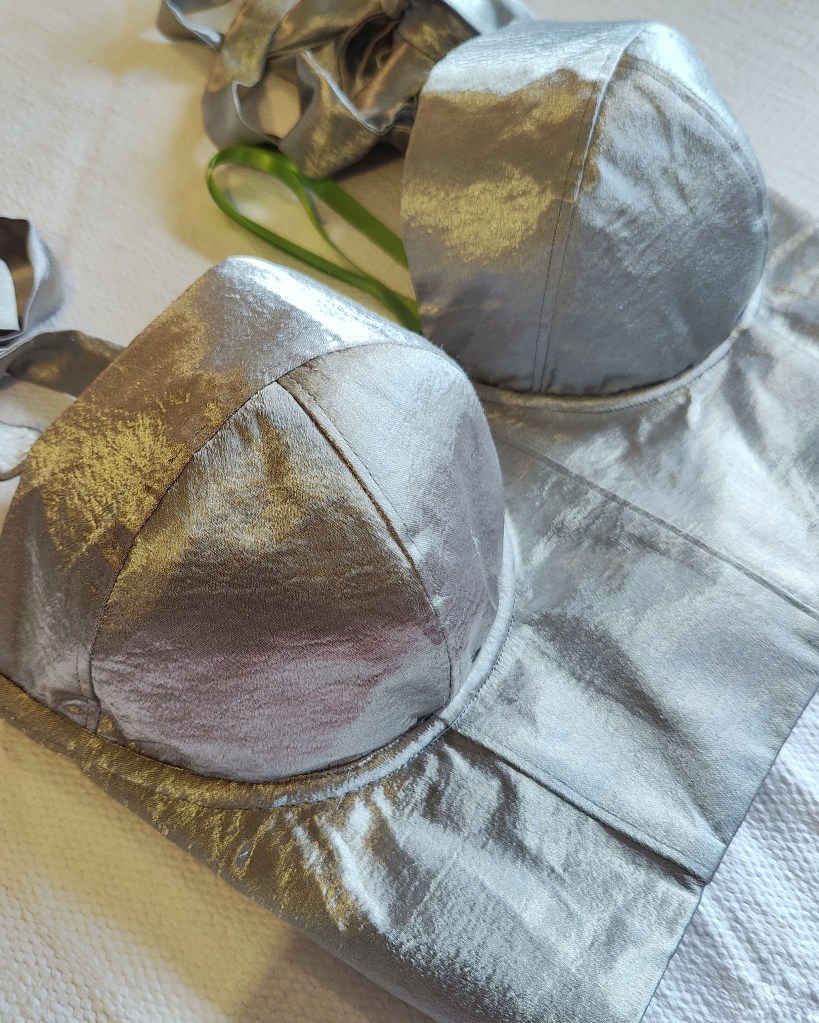
In all honesty, I don’t think it’s a bad pattern overall – there’s a lot of good to be had in it and the updated version certainly has the most size inclusivity (across cup and dress size) that I’ve seen in this type of design. I’m not a pattern designer but common sense tells me that this sort of design would be an absolute beast to grade; to achieve that beautiful, close-fitting, supportive final look you need to have so many measurements millimetre perfect. That’s hard when sewing literally just for your own size, let alone a pattern that is meant to fit anyone that uses it – glad that’s not my job!
However, it is someone’s job. And while I’m not expecting pattern designers to create a magic pattern that will fit everyone straight out the packet with no adjustments, I am expecting them to create a pattern with enough information in it for people to be able to make personalised adjustments and enough guidance to feel supported and knowledgeable enough to do so. I do not feel that was achieved with this pattern. Let’s talk about it.
Keys to success
The trick with a pattern like this both getting the right size in the bodice and cup pieces AND the right fit in the cup pieces. Unlike a looser top, where an slightly poor fit in one area can be covered for/hidden by a better fit in another area, there is no room to hide in a bustier top. Additionally, because the cup and bodice fit are so interlinked, a poor fit in one (e.g. cup) can create a poor fit in the other (e.g. bodice). This makes it doubly tricky to fit because unless you know what the root cause is behind your fit problem, you could be completely barking up the wrong tree by trying to fix a problem that’s only a supplementary issue, not the root cause. A great example of this is what happened to my final version – the centre gore doesn’t sit flat against my sternum and the fabric wrinkles and folds around the centre gore. A common assumption for what is causing this is that the bodice is too big – it sits away from my chest because there is too much fabric in the top. However, that’s the supplementary issue. The root cause for the issue is that the cups are too small – there is not enough space in the cups to encompass my whole boob. As a result, parts of my breast tissue is being pushed down, out and up, meaning that the underwires can’t sit flush against my body, causing crinkling of the fabric around the centre gore.
The amount of success you have straight out the packet will definitely depend on how well your natural boob shape matches with the pattern’s boob shape (as with any bra pattern) and how busty you are. The less busty you are, the more you’ll be able to make do with a less than perfect fit and conversely, the more boob you have, the more important it is to have a really good fit because it’s more obvious when things don’t fit well. Basically, the more boob you have, the better the engineering has to be to support the bust.
Cup Shape
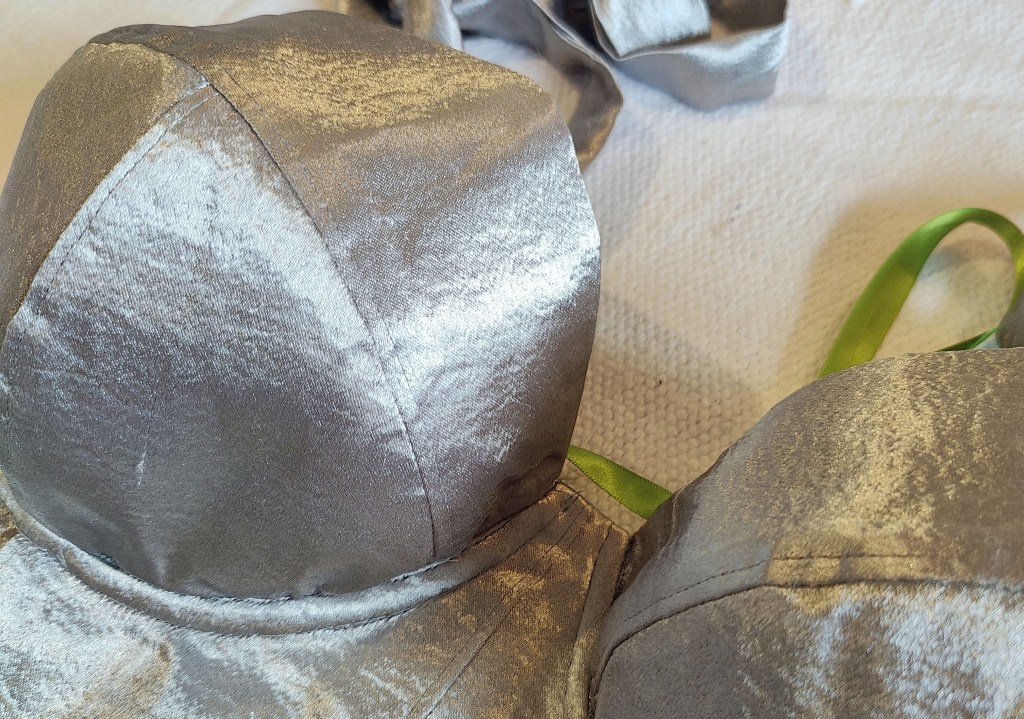
We’ll start with the cup shape because it will be the shorter section by far. The cup shape as drafted fit my natural boob shape really well and as a result, I didn’t really think much about it until I started writing this blog post. I didn’t have to make any adjustments to the cup shape, which I know is not the case for everyone (Seriicis has a super informative story highlight on instagram about her fitting experience with this dress).
The default for cup patterns in general (and this pattern is no exception) is for a round and even boob shape, which aligns with my natural shape – round and evenly full. If this is not your natural boob shape and you have bottom-heavy, top-heavy, side-full, wide-set, or centre-full breasts, you are likely to have to make some changes to the cup shape. If all of this feels like gibberish to you, these posts (one and two) do a decent job at explaining the basics of breast shape.
Considering the importance of a good cup fit, you’d assume this would all be covered in the instructions. Unfortunately, you’d be wrong in that assumption. To me, it feels vital in a pattern like this that there should be some troubleshooting tips on common fit issues and how to solve them but in lieu of that, I guess my top tip would be to take the time to understand your own bust shape and how that translates to cup shape, which should give you a good starting point on what (if any) adjustments you need to make.
Cup Sizing
Now this is where we start getting technical. The way the sizing is calculated on this pattern is odd. It took me a long time to puzzle out what the designer meant, and how that translated to the actual pattern pieces and the impact that had on choosing the correct size. I have a lot more bust-fitting and bra-sizing experience than the average person and this still took me a long time to figure out – which immediately is a red flag for me. Call me crazy, but I do not think choosing your size should be one of the most difficult parts of sewing a garment. I think the biggest issue that causes confusion in choosing a size for this pattern is that the pattern uses absolute cup sizes. This is not the same as bra sizes, which use relative sizing. Before we dive into absolute sizing, let’s recap relative sizing, so we’re all on the same page.
Essentially, cup size in bras represents a proportional volume. I often think about it in terms of visuals – a DD is visually/proportionally the same amount of boob on each person. However, someone that is double the size of someone else will need double the amount of boob to appear ~visually~ the same amount of busty. This is why sister sizing exists – your absolute boob volume remains the same but if you go up a band size, your boobs represent a smaller proportion of your size and thus, the cup size goes down.
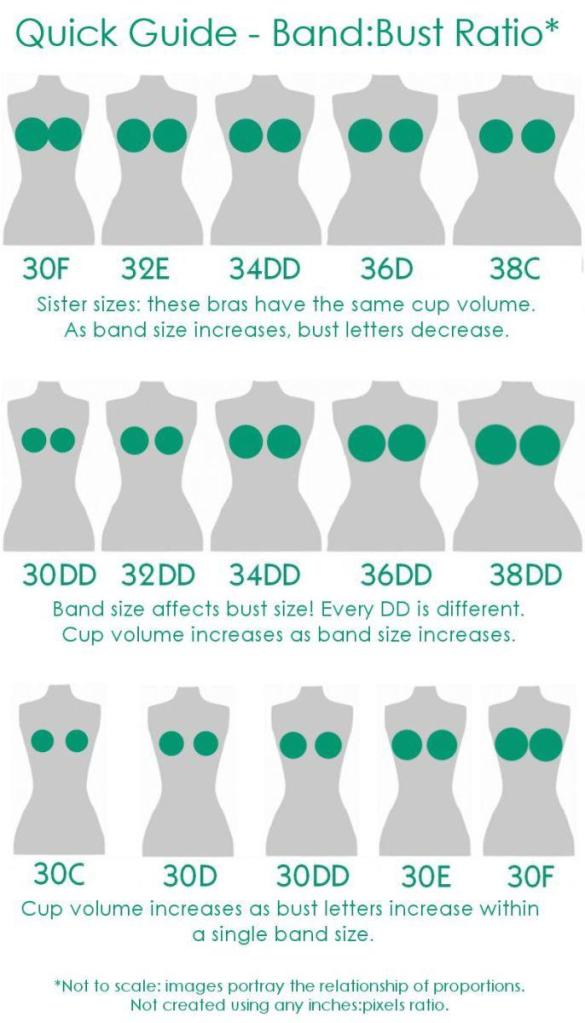
However, if you use absolute cup sizes, this all goes completely out the window. An absolute cup size means that a cup size (e.g. F-cup) is exactly the same volume of boob across all underbust sizes. This also means that a cup size will look visually very different depending the size of person – see visual below:
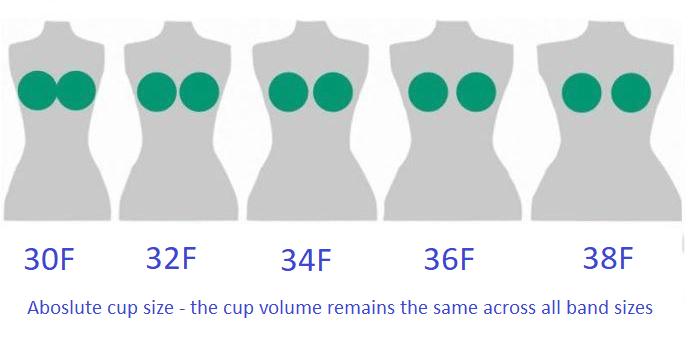
This pattern uses absolute cup sizes. The sizing guide has you measure the width of your boob across the nipple (see below) and use that measurement to determine your cup size i.e. completely irrespective of your band/dress size. It also states you can measure the internal cup width of a non-padded, well-fitting bra and use that to calculate your cup size. I am glad the pattern offers two options for measurement as there are variables that can throw off both of those measurements. For example – what about non-perky breasts where the nipple is not at the fullest part of the breast? Or very low volume breasts that take up a lot of space on the chest but don’t naturally sit “out” but rather sit “down”. And for the other option – that relies on people having a well fitting bra, which is absolutely not a guarantee.
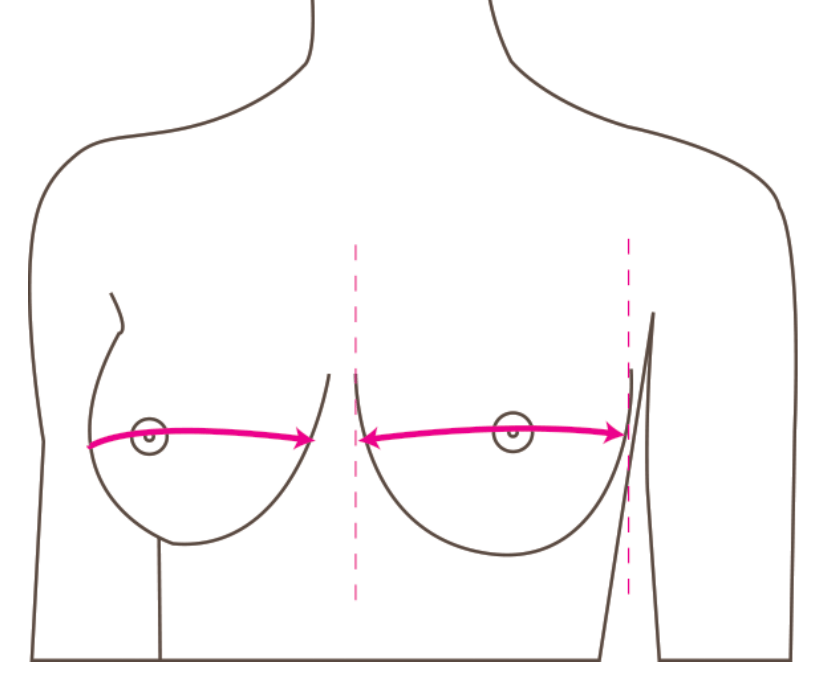
Once you’ve got your boob width, that then tells you your cup size for the pattern, regardless of what dress size you make. So if you are like me and have a single boob width of 11in, you’ll make a G-cup, irrespective of if you make a size 0 or size 20 bodice. That’s all fine once you understand it, but obviously those G-cups (boobs of 11in in width) are going to ~look~ very different on a size 0 compared to a size 20. To demonstrate this, here are the underbust measurements for both sizes:
- Size 0: 26in underbust, meaning that two G-cups (22in) represent 84% of the underbust measurement
- Size 20: 41.7in underbust, meaning that two G-cups (22in) represent 53% of the underbust measurement
Obviously, that 84% and 57% means absolutely nothing functional at all but I think it’s a really neat way to demonstrate the difference between absolute and relative cup sizes. Visually, a G-cup on a size 20 would look incredibly different to the one on a size 0. It’s the same volume of boob but very different body sizes. It’s kind of like if you get a 150cm tall woman to hold a grapefruit, it’s going to look like a much larger fruit than if it was being held by a 220cm tall man.
Because the pattern uses a very different system to how we calculate bra sizes, it’s not reasonable to assume you’ll end up with a cup size that is the same or similar to your regular bra size. Not a deal breaker, but important to understand when using the pattern. Again, something that would be worth including in the pattern instructions but is completely absent…
However, to further complicate things, any absolute scale needs a “zero point” or a reference point. This is the point at which the grading (in the case of patterns) starts from. So depending on where you fall on the size range (and how close you are to the “zero point” of grading) you could end up with a size that’s very close to your regular bra size or super crazy different. This means some people will get a cup size from the pattern that is very similar to their bra size and some people will get either a very large or very small cup size, relative to what they were expecting. Personally, it’s never a good start to a sewing experience if the size chart puts me in a size that I was never expecting in a million years, especially if other people are making more “regular” sizes. So let’s talk about who’s getting a regular size and who’s going to have a panic attack after looking at their size.
My guess is that the reference point of this pattern would be somewhere in the middle of the size range. For the sake of an example, let’s say that the reference point is size 10 – i.e. a size 10 G-cup has a boob width of 11in (which is the boob width of the G-cup in this pattern).
In regular bra sizing, as you go down band sizes (decrease the underbust) and but keep the same volume of boob, the bra cup size would increase (because you have more boob relative to your underbust size). However, the pattern doesn’t do that, the cup size stays the same as you move down band (dress) sizes. Functionally, this means that anyone making a smaller dress size than the original grading point will get a cup size smaller than their bra size. This is what happened to me. I made a size 2, G-cup and my regular US bra size is an L-cup. That’s 8 sizes smaller than my regular bra size. Pretty wild.
On the flipside, it goes the other way. If you take that same amount of boob volume and increase the dress size, in regular bra sizing, the cup size would decrease (because you have less boob relative to your underbust size). Again, the pattern doesn’t do this and so people making a dress size bigger than the original grading point will get a cup size bigger than their regular bra size.
I don’t think it’s possible to back calculate exactly where that original point was, but it’s incredibly important to keep in mind, especially at the far ends of both the cup and dress sizing ranges. I’d hazard a guess that an 11in boob width on a size 20 would be around about the D-cup range. Personally, I’d be nervous and concerned if I was normally a D-cup and a pattern tried to tell me I should make a G-cup, with no further explanation as to why this was so different to my regular bra size.
However, despite the frustrations of figuring out the sizing intricacies of this pattern, I do actually really like that the absolute sizing of the cups takes the guesswork of sister-sizing out of your hands due to the cup and dress sizes being calculated independently. If your cup volume matches the G-cup then that’s that. Full stop. If you make a G-cup, size 10 version and it fits well in the cup but too big in the dress then you can make a G-cup, size 8 version and the sister sizing is done automatically. Equally, if your G-cup, size 10 dress fit well in the body but was too small in the cup, you can just make an H-cup size 10 dress and that’s that. I think it’s a neat way of tackling such a complex sizing issue but it ONLY works if it communicated effectively, because it is such a departure from what people expect (because of how bra sizing works). I do not think this was communicated effectively and when I tried via multiple platforms (Etsy, email and instagram DM) to contact the designer for sizing assistance, I got no response, which was also very disappointing.
Size inclusivity
When I bought this pattern, it was advertised as “sizes 0-20, cups AA-K with separate cup pattern pieces”. Like the Calvin Crop, this description really heartened me and made me feel like my size would be included within that. It is worth noting this belief was actually a mistake on my behalf – I thought the sizing was in UK sizing (of which I am a J-cup) not US sizing (of which I am an L-cup).
However, thanks to the magic of absolute cup sizes, my size actually was included in this size range (even though I technically fall outside it). Because I made a dress size that was clearly smaller than the “reference point” for cup sizing, my cup sizing in this pattern was smaller than my bra size. But on the flipside, not all K-cups will actually be accommodated for in this pattern. If you genuinely wear a bra K-cup and a dress size of 18, there is no way that is actually included in the size range (source: common sense and a 15 years of bra-fitting experience).
I will note that since I bought the pattern, the description has been updated to remove cup-sizes from the actual description – it just states it includes “multiple cup sizes for each bodice size”. I think this is a great move – whilst people still have to take a stab on whether the sizing will accommodate them, at least they aren’t buying it based on false information. An even better move would be to include the cup volumes that the pattern accommodates so that people can actually know before purchase whether their bust size is included.
Another note on the size inclusivity of this pattern is that the number of cup sizes offered for each bodice size differs WILDLY. As in, there is a different number of cup sizes offered for each dress size, which I’ve listed below:
- 0: AA-F (7)
- 2: AA-G (8)
- 4: AA-H (9)
- 6: AA-I (10)
- 8: AA-J (11)
- 10: AA-K (12)
- 12: A-K (11)
- 14: B-K (10)
- 16: C-K (9)
- 18: D-K (8)
- 20: E-K (7)
Genuinely baffling. Like I said for the Calvin Crop, I don’t think you can market a pattern as size inclusive if you are not offering the same opportunity for sizing across your range. Size 10s get almost double the cup size options than size 0s and 20s. Lucky size 10s, I guess? This is however a HUGE step up from the one cup size and little guidance on an FBA and no guidance on a SBA offered in the Calvin Crop. It’s also worth noting that the Rose Café Bustier is a third cheaper than the Calvin Crop.
Conclusions
I think people on Instagram get so caught up with how the final vision looks (which often is fantastic) that they forget about all of the frustrations they had on the way there. I didn’t see any truly critical Instagram posts of this dress, which can either be a green or red flag, in my opinion. However, when I started sharing my process, I had loads of people message me sharing stories of frustrations and failed attempts at this dress, with some not even making it past the “choosing a size” phase (which I can fully sympathise with). This post is over 3000 words long and basically all I’ve talked about is how to choose a size. It shouldn’t be that complicated!
But there’s a huge discrepancy with the oodles of gushing posts about how beautiful and elegant the pattern is and people’s private experiences with this pattern, which really frustrates me. Maybe the people behind the public posts I saw really didn’t have any issues with it. Maybe it’s super easy to make in the AA-C cup range and those were the only examples instagram would show me. Maybe the instagram sewing community has an issue with over-politeness. Maybe it’s a combination of all of the above.
Drafting for fuller busts shouldn’t be an afterthought. Drafting for plus size people shouldn’t be an afterthought. Pattern designers shouldn’t be conflating “lack of knowledge” with “too difficult”. If you don’t understand the differences between drafting for small breasts and large breasts, or straight sizes and plus sizes, then don’t pretend to include them in your pattern. Go back and learn how to draft for those sizes. Give people the information they need to be able to use your pattern effectively. If you are using sizing techniques and terms that are not common, explain what they mean. Support people to understand. Home sewists are capable, resilient and have have way too much determination to give up at the first hurdle. We want to understand, but we aren’t professionals and we aren’t mind-readers. I have about 2kgs of boob that I’m slinging around on a daily basis; I have way too much neck tension and too many shoulder issues to be bothered with unlocking any latent telepathic abilities.
We all deserve clothes that fit.
It should not be a fight to get them.

 Willadee Makes
Leave a comment